
The maps we use to navigate consciousness
Part 1 of 4 in the "Rethinking Mind" series

Two clients sit in my office describing similar struggles with overwhelm, but their language reveals something important.
The first says: "Something's broken in me. I need to figure out what's malfunctioning so I can fix it." She describes her mind as needing debugging, her emotions as glitches that need correcting.
The second says: "I feel like I'm drowning, like the waters just keep rising and I can't catch my breath." She talks about being swept away, about needing to find solid ground.
Both are suffering and need help. But notice how different these feel in your own body as you read them. One suggests machinery that needs repair. The other suggests a force that needs to be moved through rather than shut down.
Here's what I've learned in my practice: the metaphors we use for our minds aren't just poetic language. They shape what we think is possible, what healing looks like, and which approaches might actually help.
Metaphors aren't decoration, they're architecture
"A map is not the territory it represents, but, if correct, it has a similar structure to the territory, which accounts for its usefulness." — Alfred Korzybski, Science and Sanity (1933)
You might think metaphors are just creative ways of saying the same thing. But cognitive scientists have discovered something more profound: metaphors actually structure how we think and experience reality.
As cognitive linguist George Lakoff described in his groundbreaking work, the metaphors we use aren't just descriptive; they're prescriptive. They shape what we can imagine, what solutions we can see, and what experiences we allow ourselves to have.
I notice this in how clients relate to their struggles. When someone describes their mind using mechanical metaphors, a certain orientation follows: they seek fixes and solutions, focus on productivity and efficiency, treat emotions as problems to solve, and expect to function perfectly once they find the right adjustment. Often, they believe they should be rational and consistent at all times.
When someone reaches for water, weather, or landscape metaphors, different possibilities open. They're more receptive to cyclical rhythms, more curious about what their emotions are telling them, more willing to work with their experience rather than controlling it. They recognize that overwhelm, like storms, eventually passes.
What underlies this difference? Mechanical metaphors position us within the built, technological world, as machines among machines. Natural metaphors recognize us as part of nature, subject to the same forces, rhythms, and wisdom as any other living being.
This reveals a fundamental question at the heart of how we understand ourselves: do you view yourself as part of the world of machines, or as part of organic life?
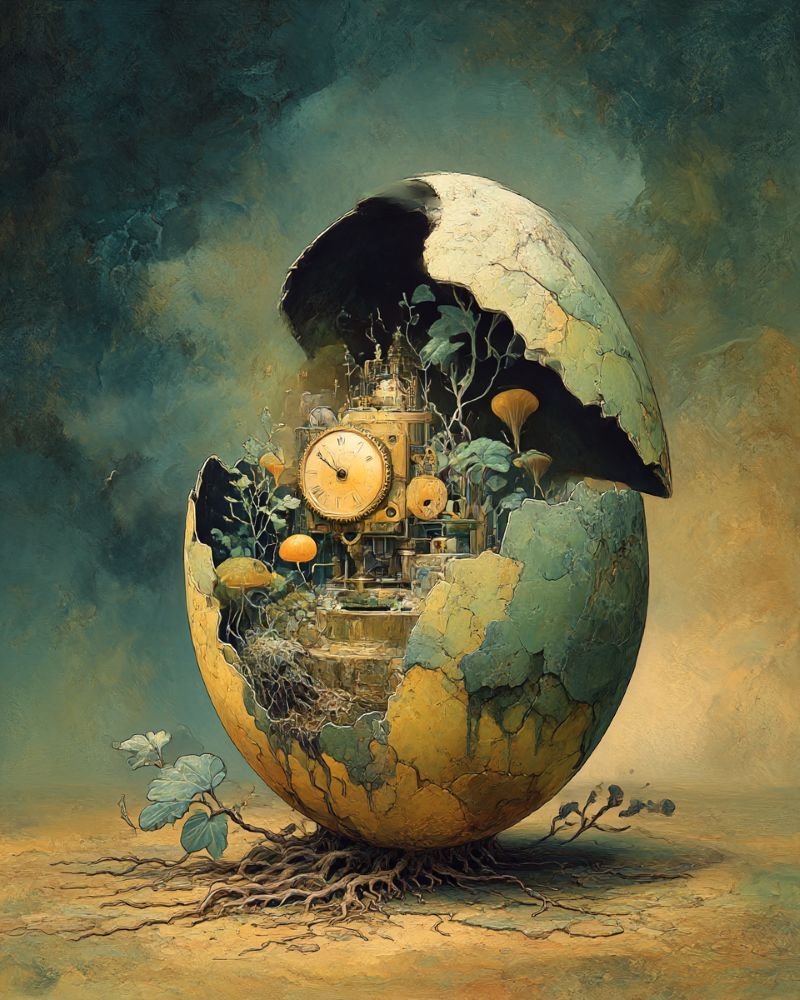
When you see yourself as part of nature, your anxiety stops being a glitch and becomes what it is for every creature: a signal, an adaptive response, information from your nervous system. Your body's reactions aren't errors to debug; they're the same primal intelligence that helps any animal navigate threat and safety.
This is the paradigm that somatic approaches work from. Somatic Experiencing®, for instance, pays attention to our animal nature, the instinctive, survival-oriented responses we share with all mammals. Your freeze response isn't a malfunction. Your hypervigilance isn't brokenness. These are the wisdom of an organism that learned, at some point, that these responses kept you safe.
Try this yourself. Consider these two statements and notice your body’s reaction to each:
"I’ve got too many tabs open. Something's not working right."
"I’m swamped. I need room to breathe."
What feels different to you between them?
This isn't just semantics. Your nervous system responds differently to these frameworks.
When the fix-it frame stops working
When we think of the mind as a computer or machine, certain assumptions follow naturally. There's a "right way" to function, and deviation means something's broken. The solution must be fixing, upgrading, or debugging. Emotions and bodily sensations become secondary to cognitive processing, just feedback signals that may or may not be accurate.
I hear this in how clients (and I) talk about emotional struggles. We say "I just need to process this," as if emotions are data files waiting to be sorted. We describe something "not wiring correctly" in our brains. We ask for better coping mechanisms, treating them as tools for the machine. We wonder, with genuine frustration, "Why can't I just shut this off?"
This language is so pervasive that most of us use it without noticing. I catch myself doing it too: running on empty, needing to recharge, being on autopilot. These metaphors feel natural because they're everywhere, but their familiarity doesn't make them the only option, or necessarily the most helpful one.
When we view ourselves as part of nature, a different orientation emerges. We might question our ability to improve upon millions of years of evolutionary wisdom. We might become more interested in observing the natural world around us as our guide, rather than designing a new operating system from scratch.
If your metaphor suggests the mind is primarily a thinking machine, therapy becomes about changing thoughts. And while cognitive work has value, many clients discover that understanding their patterns doesn't change how they feel in their bodies. They can articulate exactly why their anxiety is irrational and still feel it gripping their nervous system. They know their childhood experiences shaped their attachment style and still react the same way in relationships.
Mechanical metaphors disconnect us from felt experience. They suggest healing happens through thinking differently, when often it requires feeling differently, which means working with the body, not just the mind.
Starting from intelligence, not malfunction
In somatic therapy and body-centred approaches, we work with different frameworks. The nervous system becomes an ecosystem rather than a circuit board. Emotions carry information rather than representing errors. Healing unfolds and releases rather than requiring fixes or reprogramming. And the body is recognized as wise rather than broken.
When clients shift their metaphors, therapy shifts too. Instead of trying to "fix" their anxiety, they might learn to recognize what it's protecting. They develop capacity to be with discomfort without collapsing. They discover that their body holds wisdom their mind hasn't accessed. Healing happens through experiencing, not just understanding.
But recognizing the body's wisdom is a starting point, not the destination. Your freeze response when confronted with conflict isn't a bug; it's an ancient mammalian strategy that once kept you safe. Your racing heart before a presentation isn't irrational; it's your body preparing you. The question is whether these responses still serve you now, or whether they've become patterns that keep you stuck in old ways of protecting yourself.
Somatic therapy takes protective responses seriously precisely so they can shift. When your nervous system learns, through experience rather than argument, that what was necessary then isn't necessary now, those patterns can soften.

Which world do you live in? Noticing your metaphors
Pay attention this week to the metaphors you use for your own mind and emotions. Do you talk about needing a reboot, being short-circuited, shutting things down? Or do you see yourself more in these terms: weathering a storm, feeling unmoored, needing to come up for air?
What might become possible if you thought of your mind differently?
If you're curious about therapy that works with your body's intelligence, I offer both in-person sessions in Nelson, BC and online sessions in some provinces. Visit the Getting Started page to learn more.
If the mechanical metaphor feels uncomfortably familiar, especially the push-through, optimize, keep-performing version, you might want to read about how I work with burnout.
Coming next in this series: In Part 2, we'll explore how each era's dominant technology, from chariots to computers, became its dominant metaphor for the mind. Understanding this pattern helps us see what current metaphors reveal, and what they might be hiding.
