

Attachment counselling in Nelson, BC
Working with relationship patterns to foster connection and intimacy
Something about how you do relationships keeps repeating—different people, but similar dynamics. You may already be using the language of attachment to understand these patterns. You've thought about your attachment style, read about common relationship dynamics, traced certain tendencies back to childhood. And that understanding has helped.
But the patterns that we learned implicitly so long ago have deep roots. Maybe closeness triggers something unsettled—you start a petty argument when things are going well, or find your partner less attractive when you haven't had enough space. Or distance is what activates you—you feel mopey when alone, over-analyze communication patterns, need reassurance but feel ashamed of needing it.
These are attachment patterns at work, alongside the more general manifestations: pursuing partners who pull away, withdrawing when intimacy gets too close, finding yourself in the same dynamics no matter who you're with.
You catch glimpses of an old attachment program operating that your newer insights haven't reached. You notice it in the way your instinct responds to conflict before your mind has caught up—something learned so early it doesn't have words.
Where attachment patterns live
Attachment patterns form in the first years of life, before language develops. They're encoded not in narrative memory—the kind you can talk about—but in implicit memory: the body's automatic expectations about relationships, safety, and whether your needs will be met.
This is why understanding your patterns doesn't necessarily change them. You can articulate your attachment style clearly and still find yourself repeating the same dynamics. The patterns live in your nervous system's responses—how your body reacts to closeness, to conflict, to the possibility of rejection or engulfment. They operate faster than thought and outside conscious awareness, shaping your reactions before you've decided anything.
Working with attachment means accessing this pre-verbal layer—not only reflecting on your childhood, but attending to how your patterns are showing up right in this moment, in your body, in relationship.
“Being able to feel safe with other people is probably the single most important aspect of mental health.”
— BESSEL VAN DER KOLK
Working with attachment in individual therapy
How we work with the body
In our sessions, we track how attachment patterns show up in your body—the physical sensations, impulses, and automatic responses that arise in response to closeness, distance, conflict, and vulnerability. We talk about relationships, but importantly, while doing so, we notice what's happening in your nervous system when you imagine certain scenarios or recall certain moments.
This work draws on Somatic Experiencing® principles: approaching stressful and activating issues gradually, staying at the edges of what your system can process without becoming overwhelmed. We're building your capacity to stay present with sensations that previously triggered automatic shutdown or escalation. Your nervous system learns, through direct experience, that these states can be felt without being dangerous.
Beliefs and expectations
Attachment patterns include beliefs about yourself and others that feel like facts: "I'm too much," "People leave," "I can only rely on myself," "My needs drive people away." These beliefs have been laid down through interactions with others that reinforced and confirmed them. Whether we believe them explicitly or only implicitly, the presence of these beliefs can be shown through our behaviour.
We explore these together—not just cognitively, but noticing what happens in your body when these beliefs are active, and what shifts when they begin to soften. There's a difference between arriving at a different belief cognitively and actually feeling that difference land in your system.
The therapeutic relationship
The relationship between us becomes a place to experience new ways of relating. Therapy can function as a securely attached relationship—consistent, attuned, able to hold difficulty—and that experience ripples out into how you engage elsewhere. Your nervous system gets to have new experiences of connection that update old expectations about what's possible.
Because attachment patterns operate across all relationships, some of what plays out in your life may become observable in real time between us. When this happens, we can work with it directly—noticing together what's arising and using that awareness as material for understanding and change.
This is what researchers call "earned secure attachment": security that develops not from a perfect childhood, but from corrective relational experiences that gradually rewire what your system expects from connection.
Deepening through table work
For some clients, table work offers a way to access the nonverbal, bodily dynamics of attachment directly. This might happen during a counselling session or as a craniosacral therapy session. Hands-on work is an opportunity to simply be together in stillness, facilitating coregulation of our nervous systems, allowing your body to process what can't easily be put into words. This can be particularly helpful when patterns formed before language, though it's valuable at any point when words aren't the most direct path. You can read more about how I integrate table work on my counselling page.
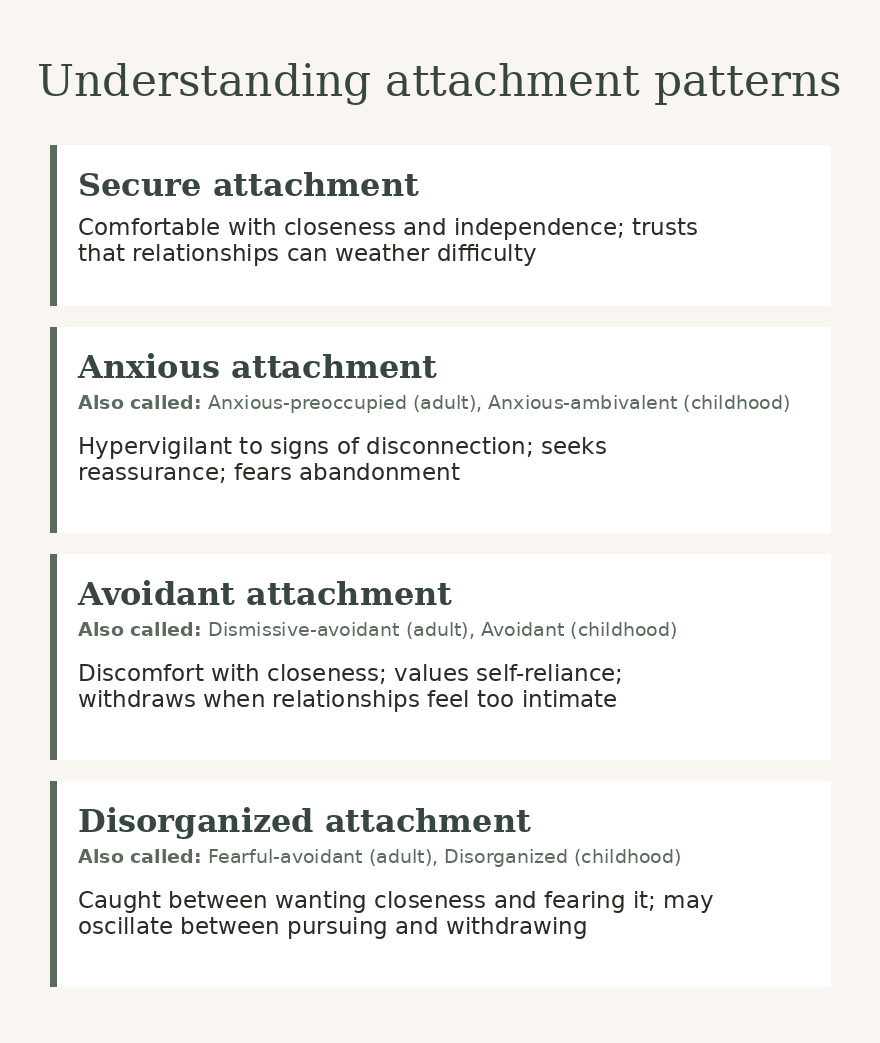
Understanding attachment patterns
Attachment patterns often show up differently across relationships—you might notice one pattern with romantic partners and another with close friends or family. And patterns developed in childhood can change. Through new relational experiences and therapeutic work, it's possible to develop what researchers call “earned secure attachment.”
What becomes possible
Working with attachment can create more space between what happens and how you respond—room to recognize old patterns as they arise rather than being swept up in them. Clients comment that there's something deeply liberating about finding themselves responding with more grace in a situation where they know they would have melted down before. Triggers will still exist, but there is great satisfaction in noticing evidence that the old program isn't running the show anymore.
Clients describe staying present during conflict instead of shutting down or escalating, and noticing the impulse to withdraw or pursue without automatically acting on it. Their relationships feel more stable and nourishing, and they begin to trust themselves to handle intimacy, its challenges, and its rewards.

Let’s connect
I offer individual counselling for attachment and relationship patterns in Nelson, serving clients throughout the West Kootenays including Castlegar, Trail, and Kaslo, as well as online across British Columbia.
As a Registered Clinical Counsellor, sessions may be covered by your extended health benefits (view rates and insurance details).
If you're ready to work with the patterns that have been running beneath the surface, I’d be glad to talk.
For what to expect, see the getting started page.
Related areas: Trauma and PTSD | Anxiety